
A Brain–Computer Interface Chessboard You Can Play With Your Eyes
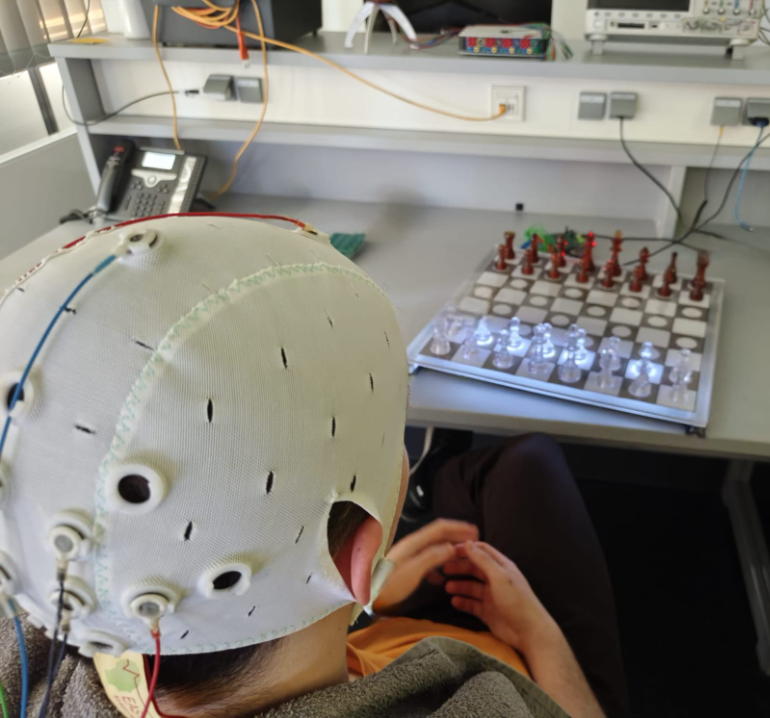
Foto: © Ivan Volosyak. A participant playing chess using the system in the BCI laboratory of Ivan Volosyak in Kleve.
A Brain–Computer Interface Chessboard You Can Play With Your Eyes
Imagine playing chess without touching a single piece. No mouse, no keyboard, no hands. You simply look at a square, and the system understands your intention.
Researchers at the BCI-Lab at Rhine-Waal University of Applied Sciences (Faculty of Technology and Bionics) have developed a chessboard that makes this possible using a Brain–Computer Interface (BCI). The system translates visual attention into chess moves by detecting brain responses to flickering light.
Turning a Chessboard into a BCI Interface
Instead of relying on external screens or flashing markers, this system embeds the stimulation directly into the chess board.
All 64 squares of the chessboard are combined in an 8×8 LED matrix, with each square containing 10 LEDs. Semi-transparent chess pieces are placed on top, allowing light to shine through them from below. When a square is activated, it flickers. By focusing on the square flickering with constant frequency, the user generates a measurable brain response known as a Steady-State Visual Evoked Potential (SSVEP).
This design turns the chessboard itself into the display for visual stimuli.
Hardware Built for Precise Stimulation
To achieve reliable flickering, the system uses a dedicated high-power LED driving stage. The board can handle up to 38 W and is controlled through a MOSFET-based switching array.
A microcontroller manages the timings and ensures that each square flickers at a precise frequency. This level of control is essential, since the brain’s response depends directly on stable and accurate visual stimulation.
The hardware architecture, including the LED driving stage and power management circuits, was designed and implemented by Atilla Cantürk (Research Assistant BCI Lab).
From Game Logic to Light Signals
A Python-based control application handles the chess logic. It determines valid moves and sends compact commands to the chessboard hardware.
The microcontroller of the novel chessboard receives these commands and activates specific LED groups. As a result, only relevant squares flicker, guiding the user’s attention and allowing legal moves. In practice, the player sees highlighted move options directly on the board, without needing a separate screen.
The Python-based control application was developed by Atilla Cantürk as part of the system integration.
How the System Understands Your Choice
Each square on the board is assigned a unique flicker frequency. When the user focuses on a square, human brain produces a corresponding signal.
An EEG processing pipeline based on Filter Bank Canonical Correlation Analysis (FBCCA) analyzes these signals and identifies the frequency being observed. From this, the system determines which square the user selected.
This allows fully hands-free interaction, driven purely by visual attention.
From Chess Puzzles to Autonomous Play
The current focus is on chess puzzles, where the number of possible moves is limited. This makes the system more robust and easier to use.
Future developments aim to expand the system toward:
- full chess gameplay with faster and more reliable selections
- longer sessions with improved stability
- robotic integration, where a robot arm physically moves the pieces on the board
The long-term goal is a fully autonomous BCI-controlled chess system.
Why This Approach Matters
This project demonstrates how Brain–Computer Interfaces can be integrated into familiar, real-world objects instead of relying on abstract computer interfaces.
By embedding stimulation directly into the chessboard and using the rules of chess to constrain user choices, the system becomes more intuitive and practical. It also highlights the potential of BCI technology for:
- assistive applications for users with limited mobility
- natural human–machine interaction
- hybrid physical–digital systems
Rather than replacing traditional interaction, this approach augments it in a way that feels direct and tangible.
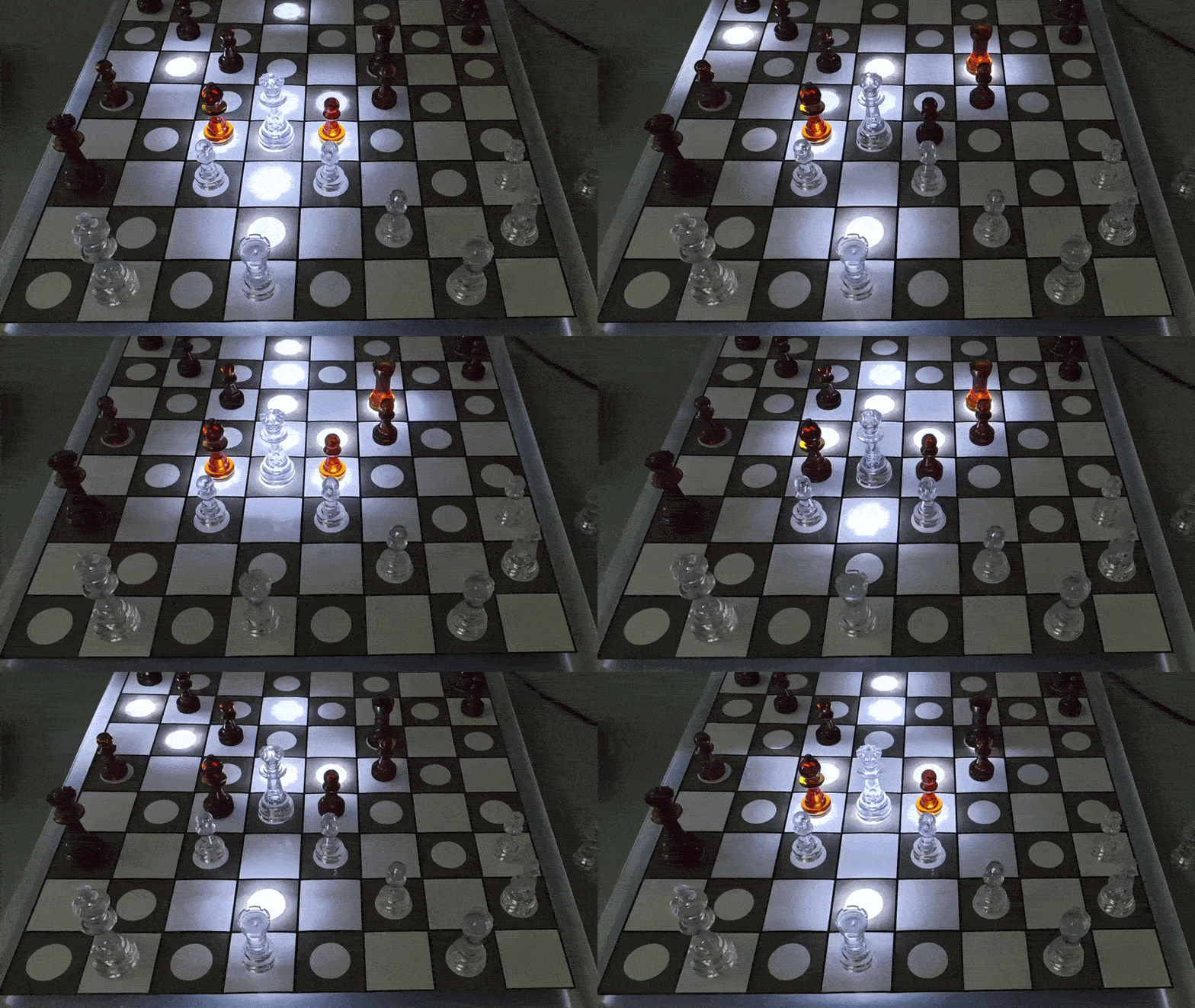
VIDEO: © Ivan Volosyak. GIF showing how the board highlights the possible moves of a chess piece. In this scenario, the queen’s possible moves are highlighted.